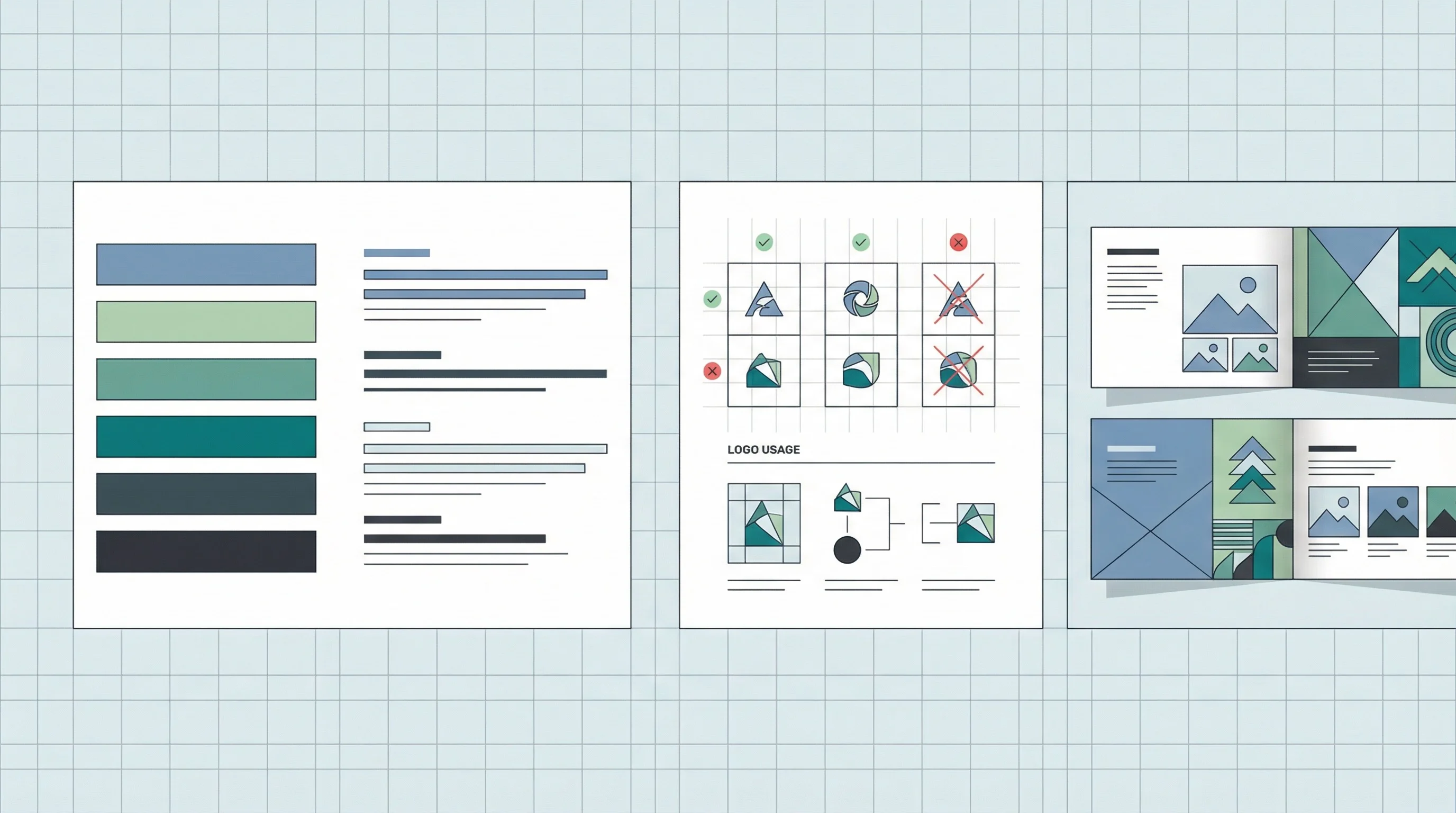
Brand guidelines are a documented set of rules for how your brand should look, sound, and behave across all touchpoints. The best guidelines are clear, practical, and organised so that anyone creating content or materials can apply them correctly without constant supervision.
Here’s the problem with most brand guidelines: nobody uses them.
They’re 60-page PDFs gathering digital dust. Created by agencies, handed over with ceremony, never opened again.
The marketing team ignores them because they’re too complicated. The sales team doesn’t know they exist. New hires never see them.
This guide shows you how to create guidelines people actually follow—and includes a template to get you started.
Why Brand Guidelines Fail
1. Too long and complex
A 100-page brand book might win design awards. It won’t get used. People need quick answers, not doctoral theses.
2. Too theoretical
Pages of brand philosophy. No practical examples. “Our brand embodies synergistic excellence.” What does that actually look like in an email signature?
3. Hidden in folders
If people can’t find the guidelines in 30 seconds, they’ll guess. Make them accessible.
4. No enforcement
Guidelines without accountability are suggestions. Someone needs to care about consistency.
5. Never updated
Business evolves. Guidelines don’t. Three years later, half the rules don’t apply to current reality.
What Effective Brand Guidelines Include
Section 1: Brand Overview (1-2 pages)
Keep it brief. This section answers “who are we?”
Include:
- Mission/purpose statement (1-2 sentences)
- Brand values (3-5, with one-line explanations)
- Target audience (brief description)
- Brand personality (3-5 traits)
- Positioning statement
Example:
Our mission: Help UK SMEs grow through practical AI automation.
Our values:
- Practical over theoretical — We focus on what works, not what’s trendy
- Plain English — No jargon, no confusion
- Implementation over advice — We do, not just recommend
We serve: UK businesses with £500k-£10m revenue looking to scale operations without scaling headcount.
Our personality: Confident, practical, direct, helpful, occasionally witty.
Section 2: Logo Usage (2-4 pages)
The most-referenced section. Make it clear.
Include:
- Primary logo
- Logo variations (horizontal, stacked, icon-only)
- Minimum size requirements
- Clear space rules
- What NOT to do (with examples)
- File formats available and when to use each
Example clear space rule:
“Minimum clear space around the logo equals the height of the ‘T’ in our wordmark. Nothing should intrude on this space.”
Example “don’ts” (show visually):
- Don’t stretch or distort
- Don’t change colours
- Don’t add effects (shadows, gradients)
- Don’t rotate
- Don’t place on busy backgrounds
Section 3: Colour Palette (1-2 pages)
Include:
- Primary colours (1-3)
- Secondary colours (2-4)
- Accent colours (if any)
- Colour values in all formats (HEX, RGB, CMYK, Pantone)
- Usage guidance (when to use which)
Example:
| Colour | HEX | RGB | CMYK | Pantone | Usage |
|---|---|---|---|---|---|
| Navy (Primary) | #1A365D | 26, 54, 93 | 100, 80, 30, 20 | 289 C | Headlines, buttons, emphasis |
| Teal (Secondary) | #319795 | 49, 151, 149 | 75, 10, 40, 0 | 7473 C | Accents, links, CTAs |
| Light Grey | #E2E8F0 | 226, 232, 240 | 10, 5, 3, 0 | — | Backgrounds, dividers |
Include accessibility note:
“Ensure sufficient contrast when placing text on colour backgrounds. Navy on white passes WCAG AA. White on Navy passes WCAG AAA.”
Section 4: Typography (1-2 pages)
Include:
- Primary typeface (for headlines)
- Secondary typeface (for body text)
- Web fonts and fallbacks
- Size hierarchy
- Usage examples
Example:
Headlines: Inter Bold Subheads: Inter Semi-Bold Body text: Inter Regular Fallback: System fonts (Helvetica, Arial)
Size hierarchy:
- H1: 32px (web), 24pt (print)
- H2: 24px (web), 18pt (print)
- Body: 16px (web), 11pt (print)
Section 5: Voice and Tone (2-3 pages)
Often overlooked. Critically important.
Include:
- Voice attributes (consistent characteristics)
- Tone variations (how voice adapts to context)
- Writing principles
- Do’s and don’ts
- Example rewrites
Example voice attributes:
Direct — Say what you mean. No waffle or corporate speak. Confident — We know our stuff. No hedging or false modesty. Helpful — Useful first. Sales second. Human — Write like a person. Not a brochure.
Example rewrites:
| Instead of this | Write this |
|---|---|
| ”We leverage synergies to drive transformational outcomes" | "We help businesses work smarter" |
| "Our innovative solutions…" | "We build [specific thing]…" |
| "Don’t hesitate to reach out" | "Get in touch” |
Section 6: Imagery and Photography (1-2 pages)
Include:
- Photography style (candid vs posed, light vs dark, etc.)
- Image selection criteria
- Illustration style (if used)
- Icon style
- Image treatment (filters, overlays, etc.)
Example:
Photography style: Candid, natural lighting, real people in real work settings. Avoid staged “handshake” corporate photography.
Image treatment: No filters. Light vignette acceptable. Never place text over busy areas of photographs.
Section 7: Application Examples (3-5 pages)
Show, don’t just tell. Include real examples of:
- Email signature
- Business card
- Letterhead
- Social media profile
- Social media post
- Presentation slide
- Website page
- Email newsletter
Visual examples are worth more than written rules.
Section 8: Templates and Assets (1 page + links)
Where to find everything:
- Logo files (all formats)
- Colour swatches
- Font files
- Presentation template
- Document templates
- Social media templates
- Email signature generator
Include access links. Make getting assets frictionless.
Brand Guidelines Template Structure
Here’s the template structure you can follow:
BRAND GUIDELINES

1. BRAND OVERVIEW
   1.1 Our Mission
   1.2 Our Values
   1.3 Our Audience
   1.4 Our Personality
   1.5 Our Positioning

2. LOGO
   2.1 Primary Logo
   2.2 Logo Variations
   2.3 Clear Space
   2.4 Minimum Size
   2.5 Logo Don'ts
   2.6 File Formats

3. COLOUR
   3.1 Primary Colours
   3.2 Secondary Colours
   3.3 Colour Values
   3.4 Usage Guidelines
   3.5 Accessibility

4. TYPOGRAPHY
   4.1 Primary Typeface
   4.2 Secondary Typeface
   4.3 Type Hierarchy
   4.4 Usage Examples

5. VOICE AND TONE
   5.1 Voice Attributes
   5.2 Tone Variations
   5.3 Writing Principles
   5.4 Do's and Don'ts
   5.5 Example Rewrites

6. IMAGERY
   6.1 Photography Style
   6.2 Selection Criteria
   6.3 Image Treatment
   6.4 Icons and Illustrations

7. APPLICATIONS
   7.1 Email Signature
   7.2 Business Card
   7.3 Social Media
   7.4 Presentations
   7.5 Documents

8. RESOURCES
   8.1 Asset Links
   8.2 Template Links
   8.3 Contact for Questions
Making Guidelines Stick
1. Keep it short
Target 15-25 pages maximum for most SMEs. 10 pages is even better. Save the detailed appendices for those who need them.
2. Make it accessible
Don’t bury it in folder hierarchies. Options:
- Shared Google Doc (always current version)
- Notion page (easy to navigate)
- Brand portal (if you have one)
- Pinned in team Slack/Teams
3. Create quick reference
A one-page cheat sheet with:
- Logo (primary version)
- Colours (with hex codes)
- Fonts (names and where to find)
- Key voice principles
- Asset location
Pin this everywhere.
4. Train your team
Guidelines without training are theory. Run a 30-minute session:
- Walk through key elements
- Show examples of good and bad usage
- Answer questions
- Identify who to ask for help
5. Assign an owner
Someone needs to care. They:
- Answer questions about brand usage
- Review materials for consistency
- Update guidelines when needed
- Enforce standards
6. Review annually
Businesses change. Guidelines should too. Annual review:
- Does this still reflect who we are?
- Are there new touchpoints not covered?
- What questions come up repeatedly?
- What rules aren’t working?
FAQs
How long should brand guidelines be?
For most SMEs, 15-25 pages is ideal. Longer documents are less likely to be used. Create appendices for detailed technical specifications.
Should we create guidelines ourselves or hire someone?
If you have the strategic foundation clear, you can create basic guidelines internally. For comprehensive guidelines with professional design and clear examples, professional help is valuable.
What format should guidelines be in?
PDF for final reference document. But also consider Notion, Google Docs, or a simple web page for easier updates and access.
How do we enforce brand guidelines?
Start with training. Make compliance easy (accessible assets, templates). Have someone review key materials. Address issues promptly but constructively.
Should guidelines include our old logo for transition periods?
Yes, if relevant. Include clear rules about when old materials can still be used and the deadline for full transition.
What to Do Next
- Audit your current materials — what’s consistent? What’s not?
- Define the essentials — logo, colours, fonts, voice
- Document clearly — using the template structure above
- Make it accessible — easy to find, easy to use
- Train your team — guidelines without training fail
Need help creating brand guidelines that work? Talk to us →
Related Articles: