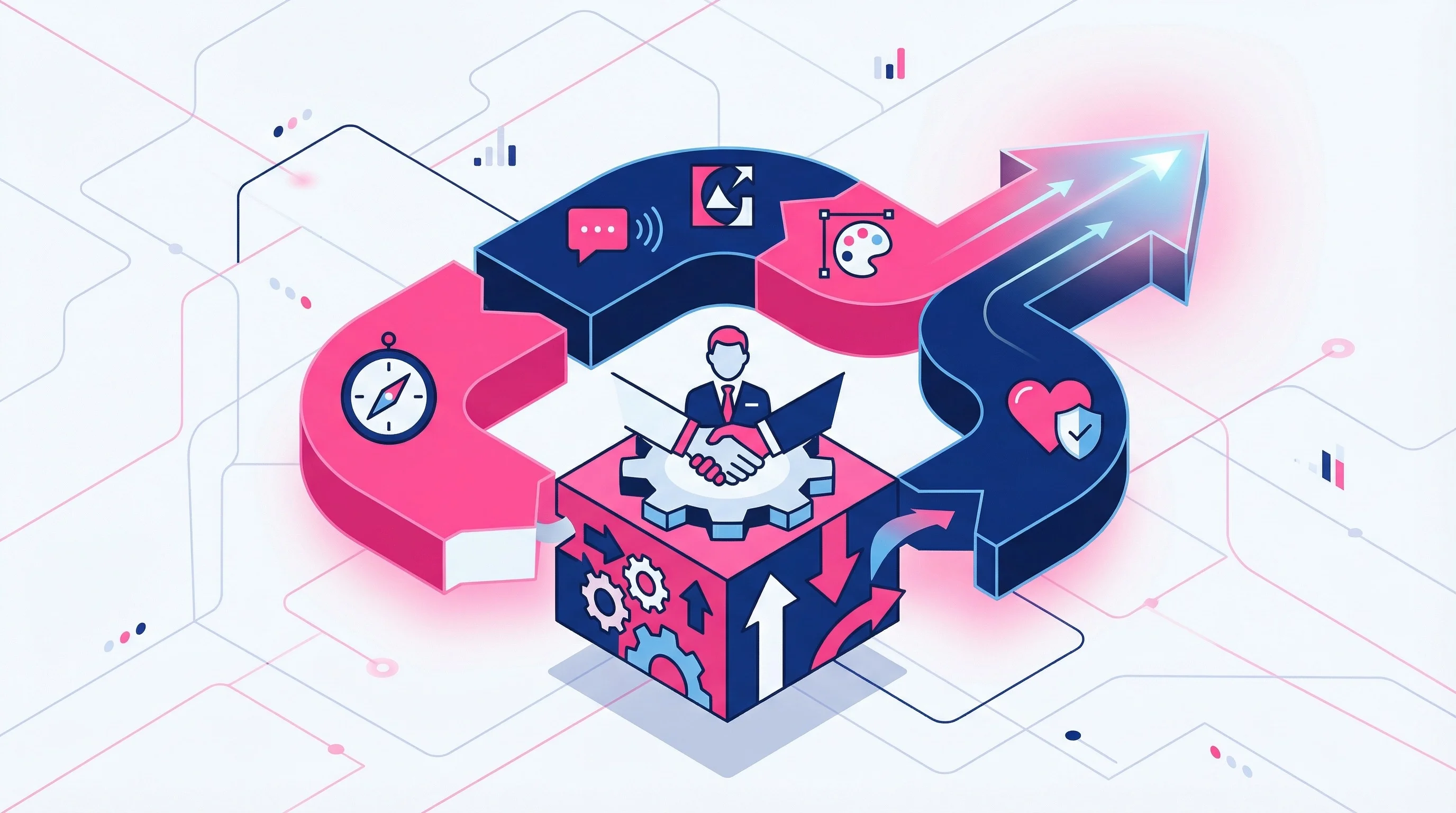
Brand strategy for SMEs is the deliberate positioning of your business to occupy a distinct place in your customers’ minds. It encompasses your positioning, messaging, visual identity, and customer experience—all working together to make your business the obvious choice for your target market.
Here’s the thing nobody tells you about branding: most of what you’ve been sold is expensive decoration.
A pretty logo. Nice colours. A clever tagline. That’s not brand strategy. That’s design work. Useful, but not transformative.
Real brand strategy answers harder questions:
- Why should anyone choose you over alternatives?
- What do you stand for that matters to your customers?
- How do you show up consistently across every touchpoint?
- What’s the story that makes people remember you?
Get these right, and branding becomes your most powerful competitive advantage. Get them wrong (or ignore them), and you’re competing on price forever.
What Brand Strategy Actually Means
Let’s clear up the confusion.
Brand ≠ Logo
Your logo is a symbol. It’s important, but it’s about 5% of your brand.
Brand ≠ Visual Identity
Colours, fonts, imagery—these are expressions of your brand. They’re not the brand itself.
Brand = Reputation + Expectations
Your brand is what people think and feel when they encounter your business. It’s the mental shortcut they use to decide whether to trust you.
Brand strategy is the intentional work of shaping those thoughts and feelings.
Why SMEs Need Brand Strategy
“But I’m a small business. Branding is for big companies.”
Wrong. Here’s why brand matters MORE for SMEs:
You can’t outspend competitors.
A big company can buy attention through advertising. You need to earn attention through differentiation. Brand strategy creates that differentiation.
Trust is harder to build.
Customers have never heard of you. They’re cautious. A coherent brand signals professionalism and reliability. It reduces perceived risk.
Price pressure is constant.
Without brand differentiation, you’re a commodity. Commodities compete on price. Strong brands command premiums.
You’re everywhere and nowhere.
As the founder, YOU are the brand. Brand strategy gives you clarity about how to show up consistently—in sales conversations, content, networking, everywhere.
The SME Brand Strategy Framework
Here’s the complete framework, step by step:
Step 1: Define Your Positioning
Positioning is the foundation. It answers: what space do you occupy in your market?
The positioning statement formula:
For [target customer] who [need/problem], [your company] is the [category] that [key benefit] because [reason to believe].
Example:
“For UK manufacturing SMEs who struggle with operational efficiency, T40 is the AI consultancy that actually implements solutions (not just advises) because we’ve built 100+ automation systems across 50 industries.”
Work through each element:
Target customer: Be specific. Not “businesses” but “manufacturing SMEs, £2-10m revenue, 20-100 employees.”
Need/problem: What keeps them awake? Not vague challenges but specific pain points.
Category: What are you? Consultancy, agency, service provider? This sets expectations.
Key benefit: What’s your primary differentiator? One thing, not five.
Reason to believe: Why should they believe your claim? Proof, credentials, approach.
Step 2: Identify Your Brand Pillars
Brand pillars are 3-5 core themes that define your brand.
Exercise: Ask yourself and your team:
- What do we want to be known for?
- What values guide our decisions?
- What makes our approach distinctive?
- What do clients consistently praise about us?
Example brand pillars:
A B2B consultancy might have:
- Pragmatism — We focus on what works, not what’s trendy
- Implementation — We don’t just advise, we do
- Plain English — No jargon, no confusion
- Partnership — Long-term relationships, not transactions
- Results — We’re judged by outcomes, not outputs
These pillars guide every decision: content topics, hiring, service design, communication style.
Step 3: Craft Your Messaging
Messaging is how you communicate your positioning consistently.
The messaging hierarchy:
Tagline: 3-7 words that capture your essence.
- Nike: “Just Do It”
- Apple: “Think Different”
- For an AI consultancy: “AI That Actually Works”
Elevator pitch: 30-second explanation of who you are.
“We help manufacturing businesses automate their operations. Most consultants give advice and leave. We implement the systems, train your team, and make sure it actually works. Our clients typically save 20+ hours per week within 90 days.”
Value propositions: 3-5 specific benefits with proof.
- “Cut operational costs by 20-30% through intelligent automation”
- “Free up 20+ hours weekly from repetitive admin tasks”
- “Implementation in 6-8 weeks, not 6-8 months”
Objection responses: Pre-prepared answers to common concerns.
“AI is complicated” → “We translate the complexity. You focus on your business.” “It’s too expensive” → “Compare our fee to one year of the time you’ll save. ROI is typically 6-12 weeks.”
Step 4: Develop Your Visual Identity
Now—and only now—you work on visuals.
Logo:
- Simple enough to work at small sizes
- Distinctive enough to be recognised
- Appropriate for your industry and positioning
- Versatile across applications
Colour palette:
- Primary colour (dominant)
- Secondary colour (supporting)
- Accent colour (highlights)
- Neutral colours (backgrounds, text)
Colours carry psychological associations. Choose intentionally.
Typography:
- Heading font (distinctive, brand expression)
- Body font (readable, professional)
- Consistent use across all materials
Imagery style:
- Photography style (candid vs posed, light vs dark)
- Illustration approach (if used)
- Icon style
The visual system should feel:
- Appropriate for your positioning
- Different from key competitors
- Flexible enough for multiple applications
- Timeless rather than trendy
Step 5: Define Your Brand Voice
How you write is as important as what you write.
Voice attributes: Choose 3-5 words that define your communication style.
Example attributes:
- Direct: We say what we mean. No waffle.
- Confident: We know our stuff. No hedging.
- Human: Real language. No corporate speak.
- Helpful: Useful first. Sales second.
- Occasionally witty: Not constant jokes. But not boring either.
Voice in practice:
❌ “We leverage synergies to drive transformational outcomes for our valued clients.”
✅ “We help businesses work smarter. Plain and simple.”
❌ “T40 is a leading provider of innovative solutions…”
✅ “We help UK businesses use AI to save time and make money.”
Step 6: Map the Customer Experience
Your brand lives in every interaction. Map them all.
Touchpoint audit:
Before purchase:
- Website (first impression)
- Social media (credibility check)
- Content (expertise demonstration)
- Sales conversations (trust building)
- Proposals (professionalism)
During delivery:
- Onboarding (first experience of service)
- Communication (ongoing relationship)
- Deliverables (quality and presentation)
- Problem resolution (how you handle issues)
After delivery:
- Follow-up (continued relationship)
- Referral request (how you ask)
- Ongoing content (staying top of mind)
For each touchpoint ask:
- Is this aligned with our brand positioning?
- Does this feel consistent with other touchpoints?
- What could make this more memorable?
Step 7: Document Everything
Brand strategy only works if it’s used consistently.
Create a brand guidelines document covering:
Brand Foundation:
- Positioning statement
- Brand pillars and values
- Target audience profiles
Messaging:
- Taglines and elevator pitches
- Value propositions
- Key messages by audience
- Tone and voice guidelines
- Words to use / words to avoid
Visual Identity:
- Logo usage rules
- Colour specifications
- Typography system
- Photography/imagery guidelines
- Templates for common applications
Application Examples:
- Website pages
- Social media posts
- Email templates
- Presentation slides
- Sales materials
Make this document accessible to everyone who creates content or communicates on behalf of your business.
Brand Strategy on a Budget
“This sounds expensive.”
It can be. But it doesn’t have to be.
DIY approach (£0-500):
- Work through the positioning exercise yourself
- Use Canva for basic visual identity
- Write your own messaging using the frameworks above
- Document in a simple Google Doc
Good for: Testing ideas, very early stage businesses
Freelancer approach (£2,000-8,000):
- Hire a brand strategist for positioning workshop (£1,000-2,000)
- Hire a designer for visual identity (£1,000-3,000)
- Hire a copywriter for messaging (£500-2,000)
Good for: Established SMEs ready to level up
Agency approach (£10,000-50,000+):
- Full brand strategy engagement
- Comprehensive visual identity
- Complete brand guidelines
- Implementation support
Good for: Funded startups, growing SMEs, rebrand situations
The rule: Invest proportionally to your revenue. A £100k business doesn’t need a £50k brand project. A £5m business probably does.
Measuring Brand Strategy Success
Brand is notoriously difficult to measure. But not impossible.
Direct measures:
- Brand awareness: Survey your market. What percentage know your name?
- Brand consideration: Of those who know you, how many would consider using you?
- Brand preference: Of those considering you, how many prefer you over alternatives?
- Net Promoter Score: Would customers recommend you?
Proxy measures:
- Direct website traffic (people typing your URL = brand recall)
- Branded search volume (people Googling your name)
- Inbound enquiry quality (are the right people finding you?)
- Price sensitivity (can you maintain/increase prices?)
- Sales cycle length (does trust accelerate decisions?)
- Win rate (are you winning more deals?)
Qualitative signals:
- Unsolicited compliments on branding
- Customers describing you using your positioning language
- Competitors copying your approach
- Easier recruitment (good brands attract talent)
Common Brand Strategy Mistakes
Mistake 1: Starting with visuals
“We need a new logo.”
Maybe. But until you’ve clarified positioning, messaging, and audience, you’re decorating in the dark.
Mistake 2: Trying to appeal to everyone
“Our target market is anyone who…”
Then you’re no one’s first choice. Strong brands polarise. They attract ideal customers by being willing to repel wrong-fit customers.
Mistake 3: Copying competitors
“Our competitor’s brand looks professional. Let’s do something similar.”
Now you’re indistinguishable. Brand strategy is about differentiation, not conformity.
Mistake 4: Inconsistency
“We’ll be playful on social and formal in proposals.”
Confusing. Pick a lane. Adapt tone for context, but keep the fundamental personality consistent.
Mistake 5: Set and forget
“We did branding three years ago.”
Brands evolve. Markets change. Revisit your strategy annually. Refresh when needed.
FAQs
How long does brand strategy take?
A focused brand strategy process takes 4-8 weeks. Shortcuts exist but usually cost you later. Implementation (website, materials, etc.) adds additional time.
When should SMEs invest in brand strategy?
Three triggers: (1) Starting a business and wanting to do it right from day one, (2) Hitting a growth ceiling and suspecting brand confusion is a factor, (3) Significant business change requiring repositioning.
Can I do brand strategy myself?
Yes, for the foundation. Use the frameworks in this guide. However, outside perspective often reveals blind spots. A strategist workshop is usually worth the investment.
What’s the ROI of brand strategy?
Hard to isolate precisely. Strong brands typically command 10-20% price premiums, enjoy shorter sales cycles, and have higher customer retention. Calculate the lifetime value impact of those improvements.
How do I know if my brand strategy is working?
Your ideal customers find you. They describe you using your positioning language. You’re winning deals against competitors. Price discussions are easier. Staff can articulate what you stand for.
What to Do Next
- Audit your current brand — Is your positioning clear? Consistent? Differentiated?
- Define your positioning — Complete the positioning statement exercise
- Identify your pillars — What 3-5 themes define your brand?
- Craft core messages — Tagline, elevator pitch, value propositions
- Document and share — Create guidelines everyone can follow
Ready to build a brand that actually drives sales? Talk to us about brand strategy →
Related Articles: