Let’s get one thing straight. I don’t love M&S.
I didn’t buy this box of Bran Flakes because I have a deep, spiritual connection to the Marks & Spencer “brand story.” I didn’t buy it because I feel an emotional “affinity” with a ‘posh’ department store. I certainly didn’t buy it because I want a “relationship” with my cereal.
I bought it because I’m a middle-aged bloke, living with chronic heart disease, trying to fix my diet.
I’m cutting out Ultra-Processed Food (UPF). I need more fibre. I need less junk. That was my problem. This box was the solution.
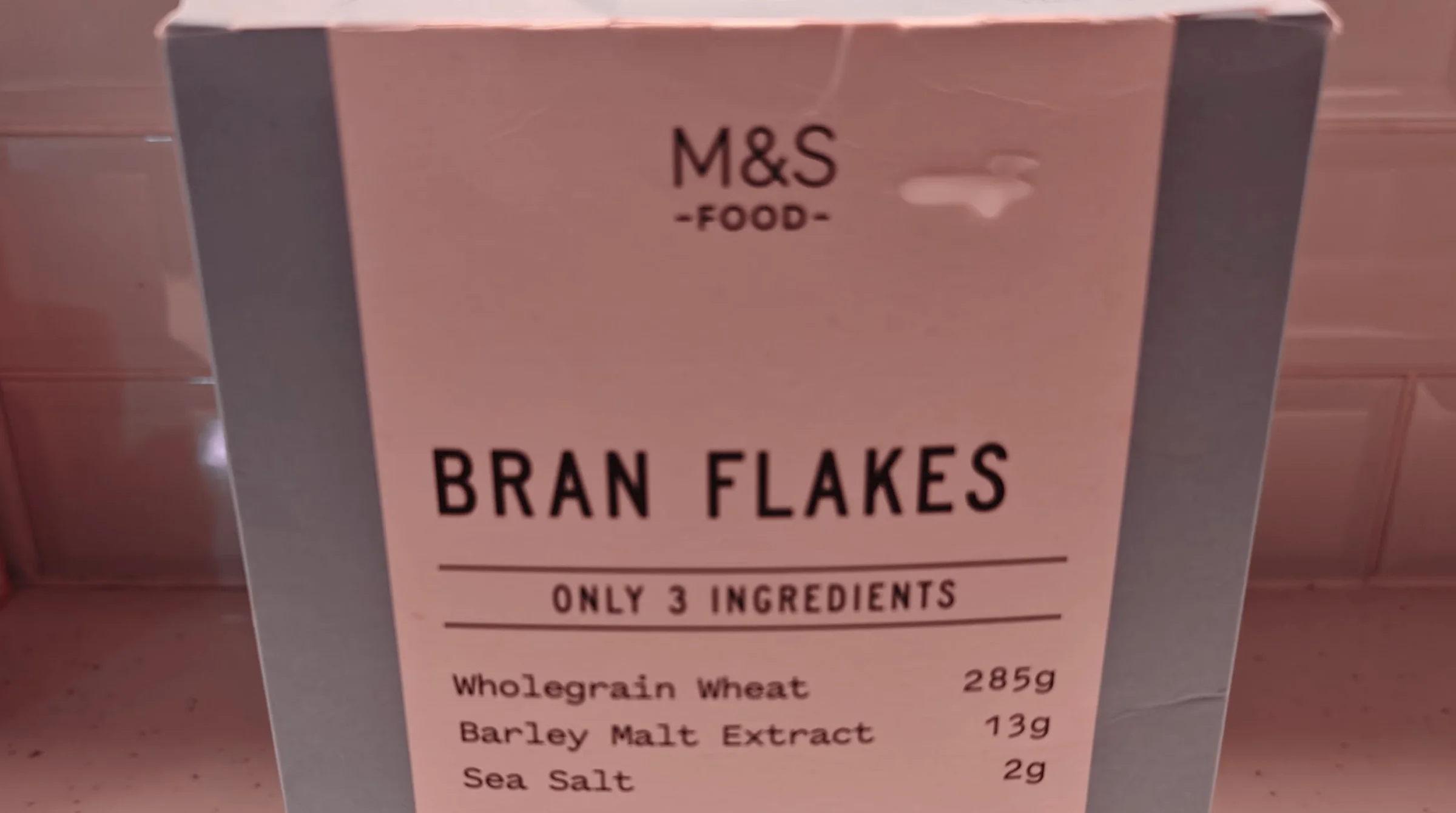
The design, in my opinion, is a cracking job of minimalism and anti-brand bullshit. It is a masterclass in what I call Commercial Cultural Engineering.
It didn’t try to seduce me with a waffling backstory about a wheat farmer named Colin. It didn’t try to “engage” me in a social conversation about sustainability or the brand’s ‘Why’.
It used a visual code—brutal minimalism—to signal exactly what I needed to know in less than a second: Wholegrain Wheat. Barley Malt. Sea Salt. Only 3 Ingredients.
Bob’s yer mother’s brother. Bang. Sold.
The Science of Indifference
This transaction is the perfect antidote to the industry obsession with “Brand Love.” What happened here wasn’t love; it was Mental Availability and Physical Availability working in perfect harmony.
In my experience, these are the foundational underpinnings of all commercial communications (let’s skip the brand hyperbole for a mo). You want to sell stuff, your customers want to buy it—let’s talk. It is that simple.
And on this occasion, it absolutely worked through three distinct phases:
The Trigger: I had a specific need state (Healthier diet/Low UPF/Heart Health).
The Signal: The design used clear, distinctive assets to cut through the noise and instantly link the product to that need.
The Transaction: It reduced my cognitive load. It stopped me thinking and getting bogged down in emotional guff about how the Founder likes to spend their weekends at Elephant Sanctuaries.
Put simply, it made the purchase automatic. The design was the utility. It communicated the value without the fluff.
A Note to Marketers
Stop kidding yourselves. Consumers are busy. We are indifferent. We are tired. We don’t want to be your friend. We just want to know if you can solve our problem before we move on to the next aisle.
If you want to sell more, stop trying to make us love you. Just make it easy for us to buy you.
Simplicity is my punchline.
P.S. The Challenger Postscript: Realism for SMEs
At T40, we hear the same pushback from the industry whenever we challenge the “Brand Love” narrative. But if you are running an SME, you can’t afford to live in a fantasy land. Here is the reality check we give our clients:
“But what about Apple and Nike?”
We hear this all the time. “People love those brands!” Yes, they do. But Apple and Nike are outliers in the 0.01%. Basing your business strategy on becoming the next Nike is like planning your retirement on winning the lottery. For the other 99.99% of businesses—especially B2B and SMEs—you aren’t selling a lifestyle; you’re selling a solution. Let’s focus on the rule, not the exception.
”But Brand Purpose is essential for the new generation!”
Is it? Or do they just want products that work and don’t destroy the planet? There’s a difference between basic corporate responsibility (which is table stakes) and wrapping a chocolate bar in a political manifesto. One is ethics; the other is vanity. Your customers are smart enough to tell the difference.
”Isn’t this cynical?”
It’s not cynical; it’s respectful. I respect my customers’ intelligence enough not to pretend my cereal is their soulmate. Real respect is saving them time, removing friction, and solving their problem.
Two Blokes. One Mission. No Fluff.