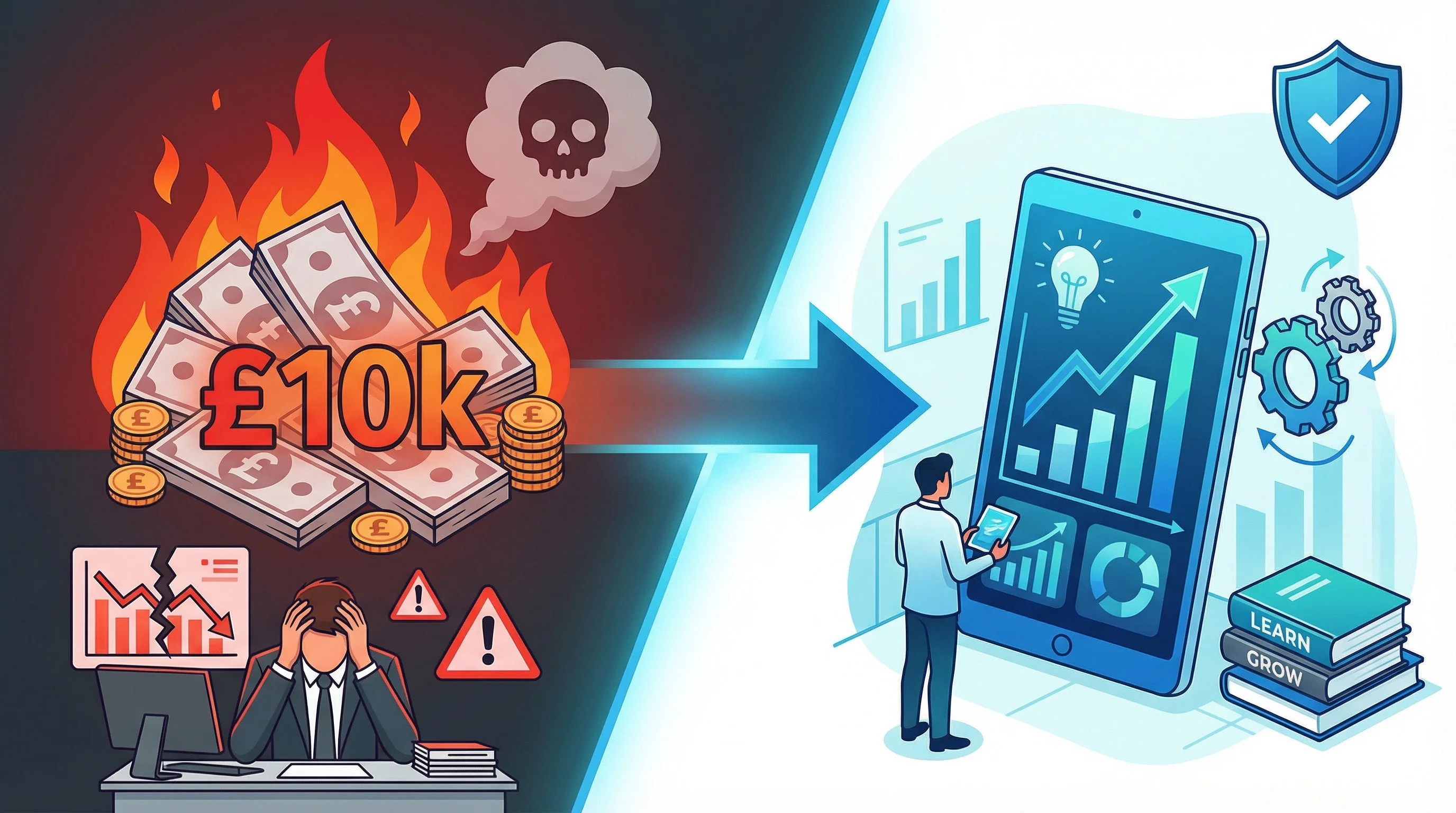
There’s one mistake that costs small businesses more money than any other.
I’ve seen it dozens of times. A business decides to “get serious about marketing.” They hire an agency or start running ads. They spend £5,000–£15,000 over 6–12 months.
And get nothing for it.
The mistake? Tactics before strategy.
The Pattern
It looks like this:
Step 1: “We need to do more marketing.”
Step 2: Hire an agency or turn on Google Ads.
Step 3: Agency asks: “What’s your target audience? What’s your messaging? What are your goals?”
Step 4: Business answers vaguely: “Um… small businesses? People who need our services?”
Step 5: Agency does their best with vague brief. Creates ads. Posts content. Runs campaigns.
Step 6: Results are disappointing. Leads are few or wrong. Spend continues.
Step 7: After 6–12 months: “Marketing doesn’t work for us.” Agency fired. £10k+ spent.
The problem was never the agency. The problem was no strategy.
What Strategy Means (Specifically)
Strategy isn’t a complicated document. It’s clear answers to simple questions:
1. Who are we targeting?
Not “businesses” or “people who need our services.”
Specific:
- Industry/sector
- Company size
- Job titles of decision-makers
- Geographic location
- Current situation (pain point they’re experiencing)
Example: “Financial services firms in the UK with 20–200 employees, where the marketing director is frustrated by compliance complexity and inconsistent agency work.”
2. What’s our positioning?
Why should someone choose you over alternatives?
Not “quality service” or “we care about our clients.”
Specific:
- What you do differently
- What outcomes you deliver
- Why your approach is better
Example: “We specialise exclusively in regulated industries, so you never have to explain compliance requirements to your agency.”
3. What’s our message?
What do we say to the target audience that resonates?
Not features. Not services. The transformation.
Specific:
- The problem they have
- The outcome they want
- Why you’re the path from problem to outcome
Example: “Stop explaining compliance to generalist agencies. Work with a team that already speaks your language.”
4. What channels will reach them?
Where does the target audience actually spend time?
Not “everywhere” or “all social media.”
Specific:
- Primary channel (where most spend goes)
- Secondary channel (testing or support)
- What you’re explicitly NOT doing
Example: “LinkedIn organic + LinkedIn ads for awareness. Google Ads for capture. No Instagram, Facebook, or TikTok — our audience isn’t there.”
5. How will we measure success?
What numbers indicate marketing is working?
Not impressions or followers.
Specific:
- Leads per month
- Cost per lead
- Conversion to sales
- Revenue attributed to marketing
Example: “20 qualified leads per month at under £150 cost per lead, with 10% converting to clients worth £8,000+ average.”
Why Agencies Can’t Save You
“But that’s what I hired the agency for!”
Agencies are execution partners. They run ads, create content, manage campaigns. The best agencies push back on vague briefs. Many don’t — they just take your money and do their best.
But even good agencies can’t invent your strategy. They don’t know:
- Why customers actually buy from you
- What objections prospects have
- What makes you different from competitors
- Which customers are most profitable
- What your business goals are
Only you know that. Or can discover it.
The Real Cost of Skipping Strategy
The £10k figure is conservative. Here’s how it adds up:
| Wasted Spend | Amount |
|---|---|
| Agency retainer (6–12 months) | £6,000–£18,000 |
| Ad spend that didn’t convert | £2,000–£10,000 |
| Content that targeted wrong audience | £1,000–£5,000 |
| Time spent managing failing campaigns | 50–100 hours |
| Opportunity cost (what you could have done) | Immeasurable |
And the biggest cost: You conclude “marketing doesn’t work” and underinvest for years.
Marketing does work. But only with strategy first.
The Fix: Strategy Before Spend
Before spending £1 on marketing:
Week 1: Define Your Target
Interview 5–10 of your best customers:
- Why did you buy from us?
- What problem were you trying to solve?
- What alternatives did you consider?
- What almost stopped you from buying?
Document patterns. This becomes your target audience definition.
Week 2: Clarify Your Positioning
Based on customer interviews:
- What do you do better than alternatives?
- What outcomes do you consistently deliver?
- What do customers say about you that they wouldn’t say about competitors?
Write a positioning statement: “We help [who] achieve [what] by [how].”
Week 3: Develop Your Messaging
Create messages that:
- Name the problem your target audience has
- Describe the outcome they want
- Position you as the bridge from problem to outcome
Test these messages informally. Do they resonate?
Week 4: Choose Your Channels
Based on target audience:
- Where do they spend time?
- What do they search for?
- How do they make purchase decisions?
Pick 2–3 channels maximum. Document why you’re choosing these and not others.
Then: Start Spending
With strategy documented, you can:
- Brief agencies clearly
- Evaluate whether tactics match strategy
- Measure against specific goals
- Adjust based on results
This four-week investment will save you £10,000+ and months of frustration.
The Quick Audit
Answer these questions. If you can’t answer clearly, you need strategy work:
Describe your ideal customer in specific detail. (Not “small businesses” — specific characteristics.)
Why do customers choose you over alternatives? (Not “service” or “quality” — specific reasons.)
What transformation do you provide? (Problem → Outcome)
Which marketing channels reach your target audience? (Not “everything” — specific channels with reasoning.)
What metrics indicate marketing success? (Specific numbers.)
If any answer is vague, stop spending and start strategising.
FAQ
How long does strategy work take?
2–4 weeks for foundational strategy. Enough to brief an agency or start campaigns with clarity.
Can’t I develop strategy while spending?
Expensive learning. Better to invest the strategy time upfront than pay for campaigns that test the wrong things.
Should I hire someone to do strategy?
For complex businesses, a fractional CMO or marketing strategist can accelerate this. But you still need to be heavily involved — only you know your customers and business.
What if I already spent £10k with nothing to show?
Not wasted if you learned from it. Use the experience to answer strategy questions. What didn’t work tells you something. Apply that learning before spending more.
Is strategy ever “done”?
No. Review quarterly. Adjust as you learn. But having a documented starting point is infinitely better than having nothing.
Related: Digital Marketing for Small Business UK | How to Choose a Marketing Agency | Why Your Marketing Isn’t Working