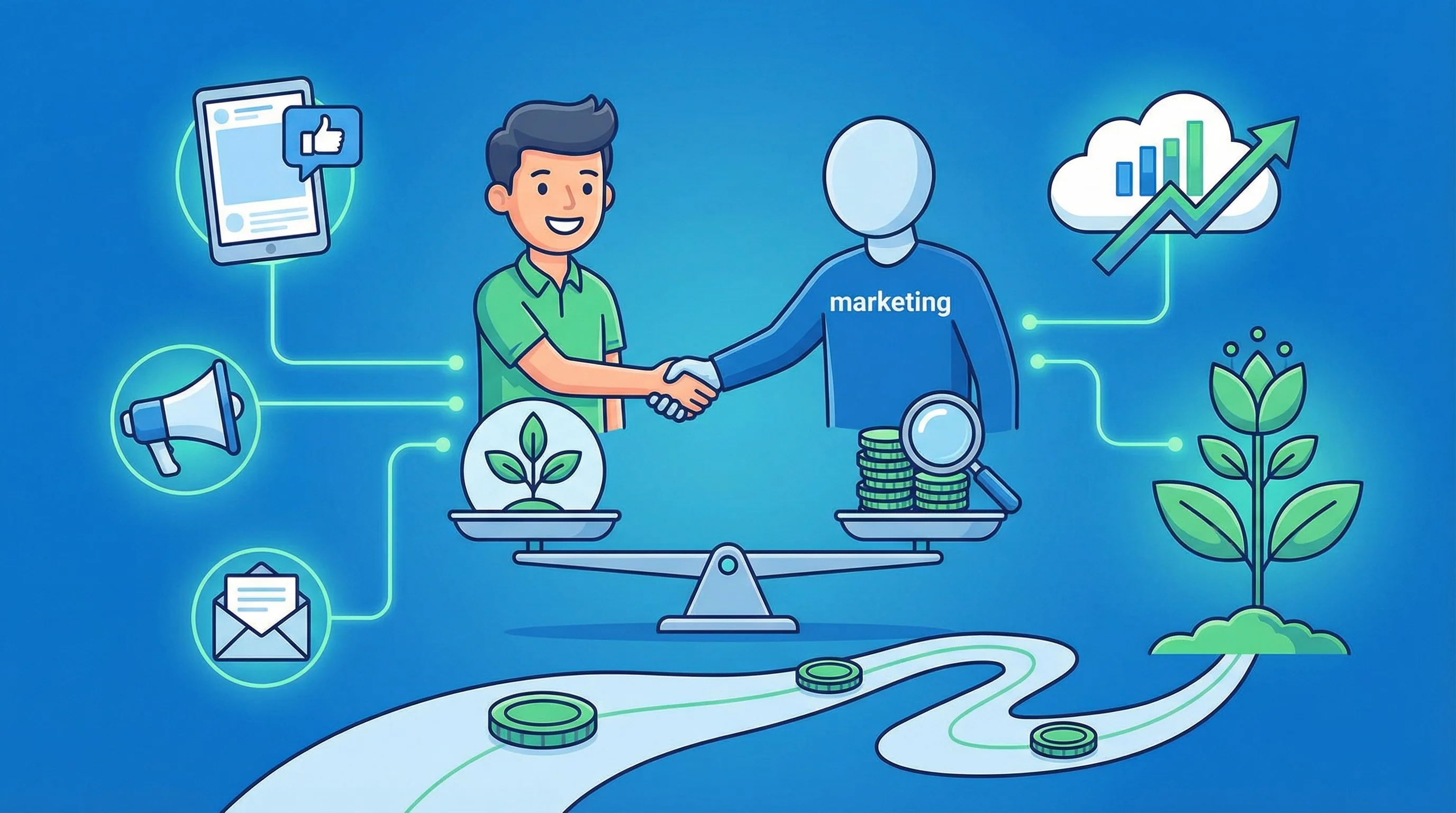
B2B marketing strategy for UK SMEs in 2026 centres on LinkedIn as the primary platform, account-based marketing for high-value prospects, and AI-powered automation for nurturing leads. Success requires longer sales cycles, multiple decision-makers, and content that demonstrates expertise rather than pushing immediate sales.
Here’s the uncomfortable truth about B2B marketing: most of what worked five years ago doesn’t work now.
Cold email? Spam filters catch 95% of it. Trade shows? Expensive and declining in ROI. Generic content? Drowning in a sea of AI-generated noise.
But here’s the good news: the fundamentals haven’t changed. B2B buyers still need to trust you before they buy. They still research extensively. They still prefer suppliers who understand their problems.
What’s changed is HOW you build that trust. This guide shows you the complete playbook for 2026.
The B2B Buying Process Has Changed
Before we talk tactics, understand the landscape:
Buyers are 70% through their journey before contacting sales.
They’ve read your website. They’ve compared competitors. They’ve watched your videos. They’ve asked their network. By the time they fill in your contact form, they’ve nearly decided.
This means your marketing IS your sales process. Not a lead generator for sales.
An average of 11 people involved in B2B purchases.
It’s rarely one decision-maker. Finance, operations, IT, end users, management—all have input. Your content must speak to multiple stakeholders.
Longer sales cycles getting longer.
Average B2B sales cycle in 2026: 3-6 months for SME purchases, 6-12+ months for enterprise. Marketing must nurture throughout.
Trust deficit is real.
Buyers are sceptical. They’ve been burned by vendors who overpromised. They need proof, not promises.
The 2026 B2B Marketing Framework
Here’s the complete strategy, layer by layer:
Layer 1: Foundation (Months 1-2)
Website as your best salesperson
Your website must:
- Clearly articulate who you help and how
- Demonstrate expertise through content
- Make it easy to start a conversation
- Work flawlessly on mobile
- Load fast (under 3 seconds)
Most B2B websites fail because they talk about the company instead of the customer’s problems. Flip it. Lead with their pain. Show you understand. Then explain your solution.
CRM and tracking infrastructure
You cannot do modern B2B marketing without:
- CRM system (HubSpot, Pipedrive, or similar)
- Website analytics (Google Analytics 4)
- Email marketing platform (integrated with CRM)
- Lead scoring system (who’s hot, who’s not)
Set this up before spending money on traffic. Otherwise, you’re filling a leaky bucket.
Ideal Customer Profile (ICP) documented
Write down:
- Industry/sector
- Company size (revenue, employees)
- Key decision-maker titles
- Problems they’re trying to solve
- Where they hang out online
- What they read/watch/listen to
Be specific. “SME owners” isn’t an ICP. “Manufacturing businesses, £2-10m revenue, 20-100 employees, struggling with operational efficiency” is an ICP.
Layer 2: Demand Generation (Months 2-6)
LinkedIn: Your primary channel
For B2B in the UK, LinkedIn isn’t optional. It’s essential.
Here’s the strategy:
Founder/leader content (most important)
People buy from people. Your company page won’t build trust. Your leadership’s personal brands will.
Posting rhythm:
- 3-5 posts per week from key individuals
- Mix of insights, stories, and useful content
- Engage genuinely with comments (this matters more than posting)
- Connect strategically with ICP prospects and influencers
Content that works:
- Industry observations and opinions
- “What I learned from [experience]”
- Simplified explanations of complex topics
- Case studies (anonymised where needed)
- Contrarian takes on common wisdom
Company page (supporting role)
Use for:
- Sharing blog content
- Company news and milestones
- Employee spotlights
- Job postings
Don’t expect organic reach from company pages. They’re for credibility, not growth.
LinkedIn Ads (precise targeting)
LinkedIn Ads are expensive (£5-20+ per click) but allow unmatched B2B targeting:
- Target by job title
- Target by company size
- Target by industry
- Target by company (account-based marketing)
Best uses:
- Promoting high-value content to ICP
- Retargeting website visitors
- Driving webinar registrations
- Building awareness at target accounts
Budget starting point: £1,000-2,000/month minimum to test properly.
Layer 3: Content Engine (Ongoing)
The pillar content strategy
Create 3-5 comprehensive guides that establish authority in your space:
- “The Complete Guide to [Problem You Solve]”
- “How to Choose [Solution Category]”
- “[Number] Ways to [Achieve Outcome]”
- “The Real Cost of [Problem/Solution]”
- “[Industry] Trends for [Year]”
These guides should be 2,000-4,000 words. Genuinely useful. Not gated (more on this below).
Cluster content
Around each pillar, create supporting content:
- Blog posts answering specific questions
- Case studies showing results
- Videos explaining concepts
- Infographics summarising data
Internal link everything. Google rewards topical authority.
Content upgrades (lead magnets)
Offer additional value in exchange for email:
- Templates
- Checklists
- Calculators
- Extended guides
- Video tutorials
Make the free content good. Make the upgrade irresistible.
Ungated vs gated debate
The old playbook: gate everything behind forms. Maximise leads.
The 2026 reality: buyers hate forms. They’ll find information elsewhere.
New approach:
- Ungate most educational content (SEO benefit, trust building)
- Gate only high-value tools/templates/exclusive content
- Use progressive profiling (ask for more info over time)
- Prioritise quality of leads over quantity
SEO: The compound asset
SEO takes 6-12 months but pays dividends forever.
Focus on:
- Problem-aware keywords (what your buyers search when they have a problem)
- Comparison keywords (your solution vs alternatives)
- Educational keywords (how to, what is, guide to)
- Commercial keywords (buy, hire, services, near me)
One excellent blog post per week, properly optimised, builds a lead-generating machine.
Layer 4: Lead Nurturing (Ongoing)
Email sequences
When someone downloads content or subscribes, they enter a nurture sequence:
Week 1: Welcome + additional value related to what they downloaded Week 2: Educational content addressing common questions Week 3: Case study or success story Week 4: Soft CTA (book a call, get an assessment) Ongoing: Monthly newsletter with valuable content
No hard selling in nurture sequences. Build trust. Stay top of mind.
Multi-touch approach
Email isn’t enough. Layer on:
- LinkedIn retargeting ads
- Google remarketing
- Occasional direct message (personal, not automated)
- Invite to events/webinars
The goal: when they’re ready to buy, you’re the obvious choice.
Lead scoring
Not all leads are equal. Score based on:
- Fit (do they match your ICP?)
- Behaviour (what content have they consumed?)
- Engagement (are they opening emails, visiting pricing pages?)
- Recency (when did they last engage?)
Sales focuses on high-scoring leads. Marketing continues nurturing low-scoring leads.
Layer 5: Account-Based Marketing (For high-value targets)
For your most valuable potential customers, flip the funnel.
Traditional: Create content → attract many leads → filter to qualified → sell ABM: Identify target accounts → create personalised campaigns → engage multiple stakeholders → sell
ABM in practice:
- List your dream clients (10-50 accounts)
- Research each account deeply (challenges, initiatives, key people)
- Create account-specific content or personalisation
- Run LinkedIn ads targeting those specific companies
- Connect with multiple stakeholders
- Provide value before asking for anything
- Orchestrate multi-channel touches
ABM is resource-intensive but delivers the highest ROI for high-value B2B sales.
The 2026 Technology Stack
Essential:
| Tool | Purpose | Budget Options |
|---|---|---|
| CRM | Contact and deal management | HubSpot Free, Pipedrive |
| Email marketing | Nurture sequences | Mailchimp, ConvertKit |
| Analytics | Website and campaign tracking | Google Analytics (free) |
| LinkedIn Sales Navigator | Prospecting and targeting | £60-120/month |
| SEO tools | Keyword research and tracking | Ubersuggest, SE Ranking |
Advanced:
| Tool | Purpose | When to Add |
|---|---|---|
| Marketing automation | Lead scoring, workflows | £500k+ revenue |
| ABM platform | Account-based campaigns | £1m+ revenue |
| Intent data | Know who’s researching solutions | £1m+ revenue |
| Video hosting | Professional video content | When video becomes priority |
Don’t over-invest in tools early. Start simple. Add sophistication as you scale.
AI in B2B Marketing (What Actually Works)
AI is changing B2B marketing. Here’s what’s genuinely useful in 2026:
Content creation assistance
AI can help:
- Generate content outlines and drafts (you refine)
- Repurpose long content into social posts
- Personalise content at scale
- Summarise research and reports
AI cannot replace:
- Your unique insights and opinions
- Genuine expertise and experience
- Relationship building
- Strategic thinking
Use AI as a force multiplier, not a replacement.
Automated nurturing
AI-powered email personalisation based on:
- Content consumed
- Industry/role
- Behaviour signals
Better open rates. Better engagement. Less manual work.
Lead scoring and qualification
AI analyses patterns to predict:
- Which leads are most likely to convert
- When leads are ready to buy
- Which content moves people through the funnel
Helps sales focus on the right prospects.
Chatbots (done well)
Chatbots work for:
- Qualifying website visitors
- Answering common questions
- Booking meetings
Chatbots fail when:
- They pretend to be human
- They can’t hand off to real people
- They’re annoying and intrusive
Measuring B2B Marketing Success
B2B cycles are long. Measure accordingly.
Leading indicators (track weekly/monthly):
- Website traffic and quality (time on site, pages per session)
- Content engagement (downloads, reads, shares)
- Email metrics (open rate, click rate)
- Social engagement (meaningful, not vanity)
- Marketing Qualified Leads (MQLs) generated
- Pipeline influenced by marketing
Lagging indicators (track quarterly):
- Revenue attributed to marketing
- Customer acquisition cost (CAC)
- Marketing ROI
- Win rate on marketing-generated leads
- Time to close for marketing-generated leads
The attribution challenge
B2B attribution is messy. A customer might:
- See a LinkedIn post
- Visit your website weeks later
- Download a guide
- Attend a webinar
- Search your brand on Google
- Fill in a contact form
Which touchpoint gets credit?
Practical approach: track first touch (how they found you) and last touch (what converted them). Accept that the middle is fuzzy. Focus on overall pipeline and revenue, not precise attribution.
B2B Marketing Budget Allocation
UK benchmarks for 2026:
Growing SMEs (aggressive growth): 10-15% of revenue Established SMEs (steady growth): 5-8% of revenue
Allocation by channel:
| Channel | % of Budget | Notes |
|---|---|---|
| Content & SEO | 25-35% | Highest long-term ROI |
| Paid ads (LinkedIn, Google) | 20-30% | Fastest results |
| Marketing technology | 10-15% | Tools and platforms |
| Events and sponsorships | 10-20% | Varies by industry |
| Design and creative | 10-15% | Professional appearance matters |
| Agency/freelancer support | 15-25% | Where you need help |
Adjust based on what’s working. Double down on winners. Cut losers.
Common B2B Marketing Mistakes
Mistake 1: Treating B2B like B2C
B2B buyers aren’t scrolling TikTok for suppliers. They’re researching solutions to business problems. Meet them where they are.
Mistake 2: Focusing on lead quantity over quality
1,000 rubbish leads create work for sales with no results. 50 qualified leads from your ICP transform your business. Optimise for quality.
Mistake 3: Giving up too early
B2B marketing compounds over time. Month 3 results won’t reflect month 3 effort—they’ll reflect month 1 effort. Commit to 12 months before evaluating.
Mistake 4: No sales and marketing alignment
Marketing generates leads. Sales complains they’re rubbish. Marketing complains sales doesn’t follow up. Both sides right.
Solution: shared definitions (what’s an MQL vs SQL?), shared goals, regular communication, feedback loops.
Mistake 5: All tactics, no strategy
“We should be on LinkedIn. We should do SEO. We should run events.”
Maybe. But why? What’s the customer journey? What’s the conversion path? Tactics without strategy waste money.
FAQs
How much should B2B SMEs spend on marketing?
Growing SMEs typically invest 10-15% of revenue. Established businesses 5-8%. More important than percentage is committing to a sustainable budget for at least 12 months.
What’s the best B2B marketing channel in 2026?
LinkedIn for demand generation. SEO for inbound. Email for nurturing. There’s no single “best”—you need a multi-channel approach with channels working together.
How long before B2B marketing generates results?
Paid campaigns can generate leads within weeks. SEO and content take 6-12 months. Full pipeline impact typically visible at 9-12 months. Commit for the long term.
Should we do ABM or traditional marketing?
Both. Traditional (content, SEO, LinkedIn organic) builds broad awareness and inbound. ABM targets your highest-value prospects specifically. Start traditional, add ABM for top accounts.
How do we measure B2B marketing ROI?
Track pipeline influenced by marketing, revenue attributed to marketing channels, customer acquisition cost, and marketing-generated lead conversion rates. Accept that attribution will never be perfect.
What to Do Next
- Audit your foundation — website, CRM, ICP documentation
- Build your LinkedIn presence — personal brands of leadership
- Create your first pillar content — comprehensive guide in your space
- Set up nurture sequences — automated value delivery
- Commit to consistency — 12 months minimum
Need help building your B2B marketing strategy? Explore fractional CMO services →
Related: Digital Marketing for Small Business UK | LinkedIn Marketing for B2B UK | Fractional CMO: Complete UK Guide